A LEGO notebook ·
The promise
Every composable system gets called “the LEGO of” something. Hardly anyone asks what that would take. So: what would it take to build another LEGO?
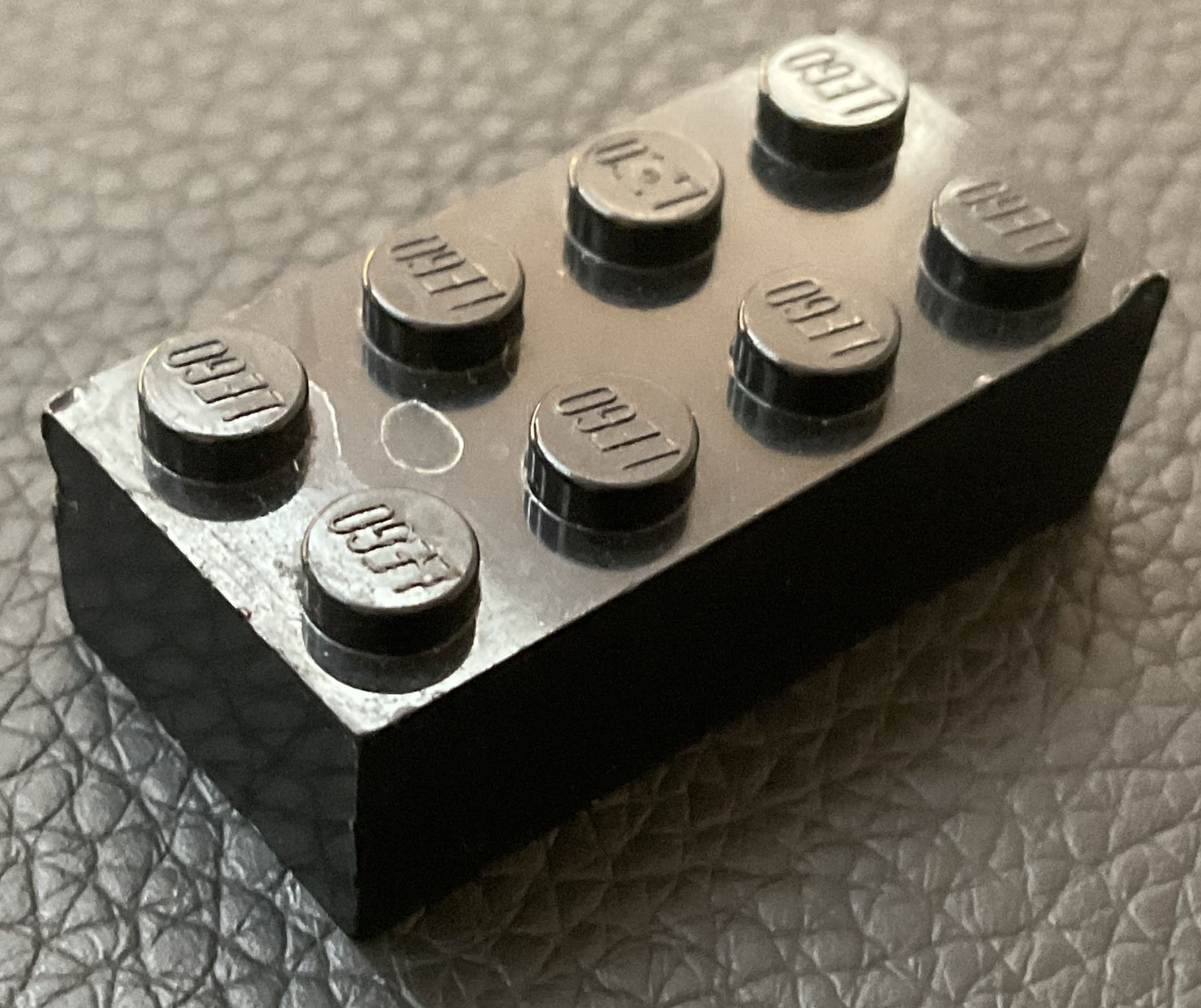
Dig to the bottom of any family's LEGO bin and there's a brick older than the child playing with it. Some grandparent's, maybe, from the seventies, the red gone a little orange. Press it onto a set opened this morning. It clicks: the same small squeeze, the same faint sound, decades apart. Almost nothing else from those years plugs into anything made today.
That click is the whole product. LEGO doesn't really sell bricks. It sells a promise: any piece, from any year, fits any other piece, exactly.
This notebook follows that promise through seventy years: how LEGO made it, kept it, nearly forgot it, and then gave it away. Each part leaves behind a rule for anyone building a system of their own.
Why it matters · The scoreboard
Value is in the pile
A part is worth what it fits. Keep every part fitting every other, and each new one makes all the old ones worth more.
Buy one of every LEGO set Rebrickable has an inventory for and you'd own about 4.6 million pieces. A brick made this morning fits every one of them. That pile, in closets and bins everywhere, is what LEGO actually owns.
LEGO ran the other experiment too, on its motors. The plug changed in 1986, 2007 and 2018, and each time the motors already in your bin stopped fitting the new ones. Imagine the bricks had done the same.
1Buy an average set every year from 1966. Then choose how often the joint changes.
And fits multiply. Two 2×4 bricks go together 24 ways; six go together 915 million, and each added brick multiplies the count by about 100. Break the joint and you lose everything it could have made with the pile.
The pile is the scoreboard. Everything that follows either grows it or shrinks it.
The pile only exists because of one decision in 1958. Before it, the bricks didn't hold.
Part one · 1949–1963
Making the promise
A carpenter's son, a patent with no numbers in it, and a plastic that could finally hold the line.
Rule 11958 · The patent
The system is the joint, not the parts
Define how parts meet, and leave the parts free. A system composes only as well as a stranger can add a part without asking anyone.
In 1954 a department-store buyer told Godtfred Kirk Christiansen, son of LEGO's founder, that the toy business lacked a system. LEGO launched its System of Play the next year. One problem: its bricks, studs on top and nothing underneath, barely held. In January 1958 Godtfred filed the fix: tubes underneath, each touching four studs of the brick below.
Read the patent and you won't find a millimetre in it. It defines the brick by what touches what, so any part that meets the rule fits every part that ever met it, including ones its designer never saw. That's how LEGO reached 9,461 shapes without checking any of them against the rest. Try it.
2Draw any part: tap squares to add or remove studs. You never draw the underside. The rule does.
Your part, from above
Its underside, written by the 1958 rule
A rule about what touches what still needs numbers. And everyone has to use the same ones.
Rule 21958–1963 · The grid
A shared measure lets strangers agree
Parts made apart only fit if they're measured in the same unit. A common unit lets designers decades apart agree without ever talking.
LEGO set its studs 8 mm apart and 4.8 mm wide, and every horizontal size fell onto one 1.6 mm unit. A designer drawing a part in 2026 lands on the same grid as the toolmaker who cut the first mould. But a grid only helps if you're exactly on it. Try being close.
3aSet your system's stud spacing. How many of your studs land on LEGO's grid?LEGOyours
3bEvery spacing from 3 to 20 mm at once. Tap anywhere on it.
The chart is all spikes. Agreement doesn't degrade gracefully: 7.9 mm is as foreign as 5. Duplo, at exactly 16 mm, sits on a spike, which is why an ordinary brick still clicks onto a Duplo brick.
When LEGO broke it · 1963Modulex
Why it made sense. Architects plan in round metric modules. Eight millimetres divides none of them evenly; five divides all of them. For a model-making kit sold to architects, a metric stud was the right call.
How it broke. A 5 mm grid meets LEGO's 8 mm only every 40 mm, so these precise, studded, LEGO-made bricks shared nothing with the ordinary pile. Modulex shows up in one year of Rebrickable's records; the business later turned to making signs.
A shared measure on paper. Then every brick has to actually match it.
Rule 31963 · ABS
Compatibility is binary, and failure compounds
A model holds only if every joint holds, so small failure rates multiply fast. Don't count on people being careful: build the precision into the tool that makes every part.
If each joint fails one time in a hundred, a 100-joint model holds about a third of the time. LEGO says 18 elements in a million fail its checks. Treat that as the odds a joint fails, and see what it buys.
4aSet how often a joint fails, then build. Each square is one joint.
4bThe share of models that hold, by size.
LEGO doesn't get there by asking moulders to be careful. The tolerance is cut once into the steel of each mould, to within 0.005 mm, and copied into every brick the mould ever makes.
When LEGO broke it · 1949–1963The first plastic
Why it made sense. In 1949 cellulose acetate was a proven moulding plastic, and LEGO was a small Danish company betting on plastic toys at all. ABS wasn't yet a practical choice.
How it broke. Acetate could shrink and warp. A stud a hair too small no longer presses against the wall above it, and a brick that meets the rule on paper falls off in hand. The rule was right; the material couldn't hold it. ABS, from 1963, could be moulded to 1/200 mm.
By 1963 the brick in the bin was possible: a rule, a unit, and steel exact enough to hold them. Every brick since has been made to that promise.
Part two · 1963–1996
Keeping it
Thirty years of new ways to connect: gears, hinges, motors, bricks for toddlers. Which ones could the promise carry?
Rule 41966–2018 · The plugs
A joint lasts as long as what it carries
Freeze the joints bound to things that don't change. A joint that carries a fast-moving technology will have to change with it, so plan for that instead of pretending.
The stud carries nothing but shape. Axles and pins carry motion; pneumatic tubes carry air. That's physics, which doesn't ship new versions. The power plug carries electricity and, lately, signals, bound to whatever electronics are current. Press play and watch what happens to each.
5Every way LEGO parts connect, by what the connection carries. Watch it grow, then tap a row.
Every connection that carries something physical is still in sets, the oldest for 77 years. Four of the five power systems are gone, and each one stranded the motors and battery boxes built for it.
When LEGO broke it · 1986, 2007, 2018The plug, four times
Why it made sense. Each new system was better. 9 volt ran power through the track; Power Functions added infrared remote control; Powered Up added Bluetooth, and motors and sensors that report back, which take more pins. Keeping the old plug meant keeping the old electronics.
How it broke. Each brought new motors, new battery boxes and a plug the old ones didn't fit; only adapter cables bridge them. The mistake isn't changing the plug. It's freezing a joint that carries electronics and promising it will last.
A dumb, exact joint can stay fixed. So how does a system grow without changing it?
Rule 51969– · Duplo and the adapters
Grow by addition, with a foot on the core
New kinds of connection can sit beside the old ones, as long as each still meets the original joint somewhere. An extension that skips the core starts its pile from zero.
Since 1958 LEGO has added two dozen ways to connect: hinges, Technic pins, ball joints, clips. None replaced the stud; each meets it somewhere. Duplo, in 1969, doubled the stud for small hands but still takes an ordinary brick. Press play and watch which survive.
6Every system LEGO grew, sorted by whether it takes an ordinary brick.
Twenty-two of twenty-two connections that kept a foot on the brick are in sets today. None of the six that didn't is. Duplo has been in sets every year since 1975.
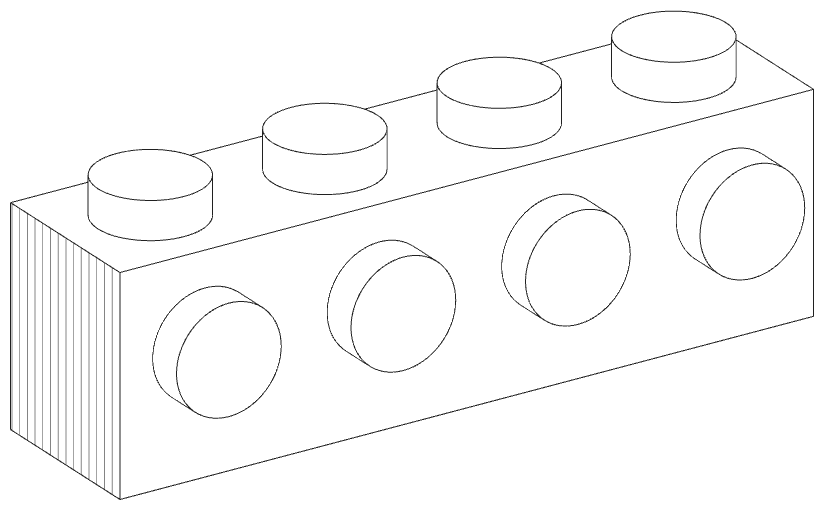
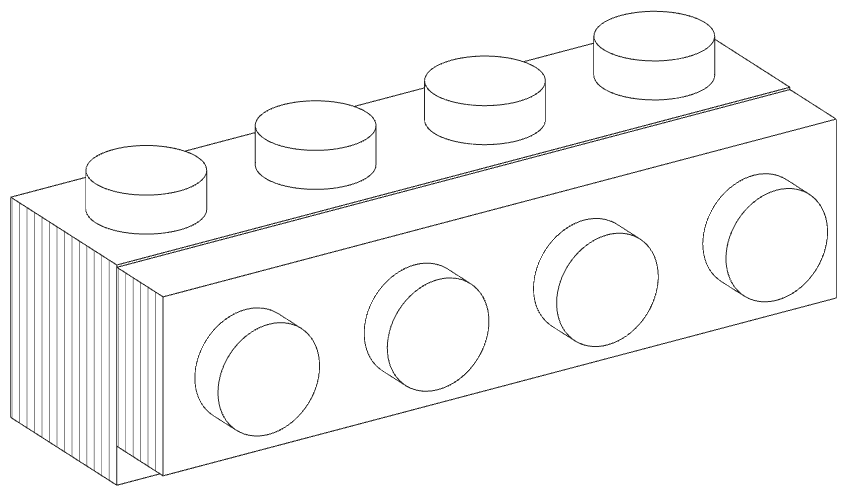
Growth also means living with seams. Sideways, LEGO counts in studs (5 grid units); upward, in plates and bricks (2 and 6). The two never line up. Rather than break the grid, LEGO kept adding adapters, bricks with studs on their sides, and builders turned the seam into a technique.
Through thirty years of gears, hinges, motors and Duplo, the brick in the bin fit every brick LEGO made. But look at the right-hand column above. Most of it arrived at once.
Part three · 1997–2006
Forgetting it
Children were turning to video games. LEGO answered with everything at once.
Line up every time LEGO broke one of its rules, on one timeline. For forty years the breaks are rare and far apart: a plastic that couldn't hold, an architects' grid, a jewellery line, a plug change. Then they bunch up.
7Every broken rule, 1949–2026. Watch it play, then tap any bar.
Between 1997 and 2004, LEGO broke three of its six rules at once in every year but one: Scala's dolls, Znap's beams, Primo for babies, then Clikits and Quatro, while the vocabulary exploded. Now look at the bottom row. LEGO lost money in 1998, the first loss in its history, again in 2000, and in 2003 and 2004, when it lost almost DKK 2 billion and nearly went under. Every loss year in its reports since 1995 sits inside the cluster. None of these were stupid decisions. That's the point.
Rule 61997–2004 · The bubble
Primitives are expensive, so make novelty cheap
A composable system's power comes from reusing a small core. Every new primitive has a cost that never stops, so budget them, and put variety in the layers that are cheap to change.
Fifty-five shapes make up half of all LEGO pieces, and designers reuse more as models get bigger. Every new shape is a steel mould; every new colour multiplies the stock of every shape made in it. In the late 1990s LEGO stopped counting.
8The vocabulary each year. Watch it play, then tap any year.
When LEGO broke it · 1997–2004The bubble
Why it made sense. LEGO's answer to video games was sets that looked like the film or the game straight out of the box: licensed worlds, specialised parts, new colours to match. Big special parts also made models quicker to build.
How it broke. Colours in use went from 37 to 98, and elements more than doubled. By David Robertson's account in Brick by Brick, about 90% of the new ones were used just once. Every one of them still needed a mould, a bin in the warehouse and a line on the inventory.
Rule 1, broken · 1979–2006Scala, Znap and Clikits
Why it made sense. LEGO wanted children it wasn't reaching. Jewellery and dolls need smooth curves and soft details that studs can't give; Znap aimed at big, light structures built from beams, like rival construction toys. Each was sensible for its job.
How it broke. Each defined its own parts and its own connectors, so each started its pile from zero and could borrow nothing from the billions of bricks already sold. None is in sets today.
Rule 5, broken · 1995–2006Primo and Quatro
Why it made sense. Babies need parts too big to swallow and soft enough to chew; toddlers need bricks that are easy to press together. A one-year-old's pile doesn't obviously need to fit a ten-year-old's.
How it broke. But children grow into the next pile, and a part that can't take an ordinary brick can't come along. Primo took neither Duplo nor the brick and lasted eleven years. Quatro took Duplo but not the brick and lasted three.
In 2004 the brick in the bin still fit every brick LEGO made. It just didn't fit much of what LEGO was trying to sell.
Part four · 2004–today
Giving it away
The turnaround went back to the brick. By then, anyone could make one.
In 2004 LEGO handed the company to Jørgen Vig Knudstorp, a 35-year-old former McKinsey consultant. The turnaround cut the element count roughly in half and gave new parts a budget: designers now spend yearly “frames,” and each new shape or colour costs one. The licences stayed. They moved up a layer.
9What each year's sets had that no other set had: the most expensive kind of novelty each one used. Then split licensed themes from LEGO's own.
Today about seven in ten sets carry something you can only get there, but only about one in twenty does it with a new mould. The rest is colour, print and minifigures. Licences sharpen the pattern. Since 1999, a Star Wars or Harry Potter set is no likelier than one of LEGO's own to need a new mould, about 6% each, and nearly twice as likely to carry an exclusive print. A licensed set is mostly ordinary bricks in costume: rule 6 kept, novelty at the surface of a structure that barely changes.
Then there's the part almost nobody mentions. LEGO doesn't own the joint any more. The brick patents expired decades ago. LEGO tried to protect the shape as a trademark instead, and lost, in Canada in 2005 and at the EU's highest court in 2010: the shape is what makes the brick work, and function is what patents are for. Anyone may make a brick that fits the one in your bin, and plenty of companies do.
10The LEGO system as layers. Build it as LEGO, then as a clone maker. What do you get for free?
And LEGO won anyway. Revenue went from DKK 6.3 billion in 2004 to 74.3 billion in 2024, with 13.8 billion of profit: the climb at the end of figure 7's bottom row. A compatible brick doesn't make a LEGO set less useful; it fits the same pile. What LEGO kept is everything above the joint: moulds exact enough to trust, a vocabulary it curates, and the worlds it licenses. Open the bottom layer and own the ones above it. For anyone building a system, that may be the most useful lesson of all.
Anyone may now make the brick in the bin. LEGO's bet is that you'll still want theirs, and so far the bet has paid.
Part five · Carrying it forward
Past the brick
LEGO kept its promise for joints that carry shape. Most systems worth building carry more.
The one thing LEGO never put in the joint
The brick doesn't know it's a castle
LEGO sells plenty of meaning: names, box art, instructions, licences, prints. It never puts any of it in the joint. Meaning rides on top, where you can throw it away.
A 2×4 brick is a wall, a wing, a dog's back. The child decides, at the moment of play, and the brick never has to know. Pick one of LEGO's most famous sets and look at what's actually in the box.
11Every piece in one set. Red: the few found in three sets or fewer. Then decide what it is.
Nearly all of the Millennium Falcon is ordinary LEGO. What makes it the Falcon is eight printed dishes and panels, a sticker sheet, the instructions and the box: the meaning layer, sitting on top of parts that don't care.
That's a design decision, and it pays three ways. It keeps the joint dumb, so the stud never has to change when the meaning does (rule 4). It lets meaning change without breaking anything: a new licence is just new paint (rule 5). And nobody ever has to agree on what anything means, because a person supplies the meaning while playing.
Software can defer meaning like that only while a person is reading the other end of the joint. Once a machine has to understand it, the meaning has to cross the joint. That's where the ladder you've been climbing starts to break.
Under every rule you've passed the same question: does it hold beyond bricks? It's really four questions. What does the rule ask of a joint that carries shape, like a stud; behaviour, like a pipe between programs; data, like a table join; or meaning, like what a company calls a customer? Here are all six rules at once.
12Six rules, four kinds of joint. Tap any cell to read it, or switch to your own verdicts and tap to re-score.
Read down the columns and the ladder tilts. Shape keeps every rule. Behaviour keeps them by staying dumb: bytes, packets, plain text. Data keeps them mechanically and still lies, because the join clicks whether or not the meanings match. Meaning keeps none.
What it takes
One joint, kept
- Specify the joint, not the parts.
- Measure everything in one shared unit.
- Make it exact, and put the exactness in the tool.
- Freeze only what carries nothing that changes.
- Grow by addition, with a foot on the core.
- Budget primitives; put novelty where it's cheap.
Keep them and the pile grows, and every new part is worth more for it. Keep them long enough and you can even give the joint away.
LEGO could keep its promise partly because it never had to keep it for meaning. The child carries that. Software's joints carry behaviour, data and meaning, and the top of the ladder is where nobody has built a LEGO yet.
So go back to the bin. Press the old brick onto this morning's set.
What would it take to build another LEGO? One joint, dumb enough to keep forever, made exactly, grown only by addition, spent carefully, and kept long enough that you can give it away. It clicks.
More LEGO notebooks
Sources and method
Figure 1: Rebrickable, pulled Nov 8, 2026: 18,851 sets with an inventory, 4,584,020 pieces, Gear and books left out, spares left out; average set size per year is pieces over sets. Plug changes in 1986, 2007 and 2018 are the first years of 9 volt, Power Functions and Powered Up in The tree of interlocks.
Figures 5–7: branch and system years from The tree of interlocks (Rebrickable, Oct 24, 2026); which connections carry what, which take an ordinary brick, and which break counts against which rule are my reading. Figures 8 and 9: from The vocabulary and The floor (same pull).
Figure 2 applies the patent's rule to whatever you draw. Figure 3 is geometry: 8 mm spacing, twelve studs, 0.05 mm allowance. Figure 4 is arithmetic on LEGO's stated rate. Figures 10 and 12 are my reading.
Figure 7's bottom row and the revenue figures: LEGO Group annual reports (1999, 2000, 2005, 2010, 2015, 2019, 2024), net profit in DKK, each year as reported in the five-year summary that covers it. Figure 11: Rebrickable, pulled Nov 8, 2026; a part's count is the number of sets whose inventory includes that part number, prints counted separately.
US 3,005,282 · The LEGO Group: A short presentation (2011): moulds to 0.005 mm, knob tolerance 0.02 mm, 18 failures per million · LEGO history: quality in every detail · Robertson, Brick by Brick: the element count, the 1998 loss and the turnaround · New Elementary on frames · BCG interview with Jørgen Vig Knudstorp · Trademark rulings: Kirkbi AG v. Ritvik Holdings (Supreme Court of Canada, 2005), Lego Juris v. OHIM (Court of Justice of the EU, 2010) · Eilers, A LEGO counting problem
Photo: Ziongarage, CC0, via Wikimedia Commons.
LEGO® is a trademark of the LEGO Group, which does not sponsor, authorize or endorse this page.