An explorable notebook ·
The essential feature
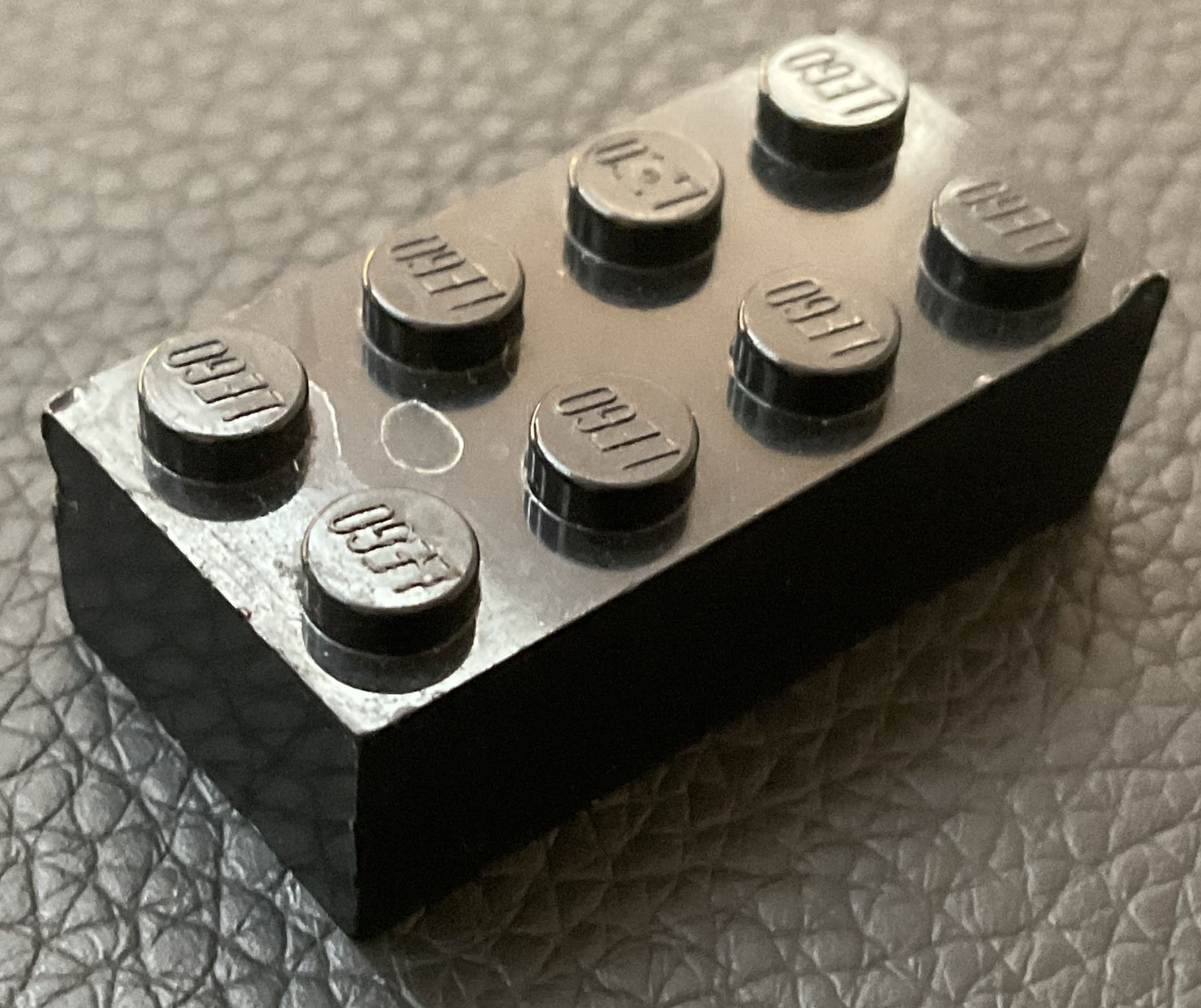
Find a LEGO brick from 1958. It still snaps onto one made this morning. Almost nothing else from 1958 plugs into anything made today. How did a toy pull that off?
The answer is a chain of decisions, and each one forced the next. Climb it one step at a time.

Step 1 · The rule · 1958
A patent with no measurements
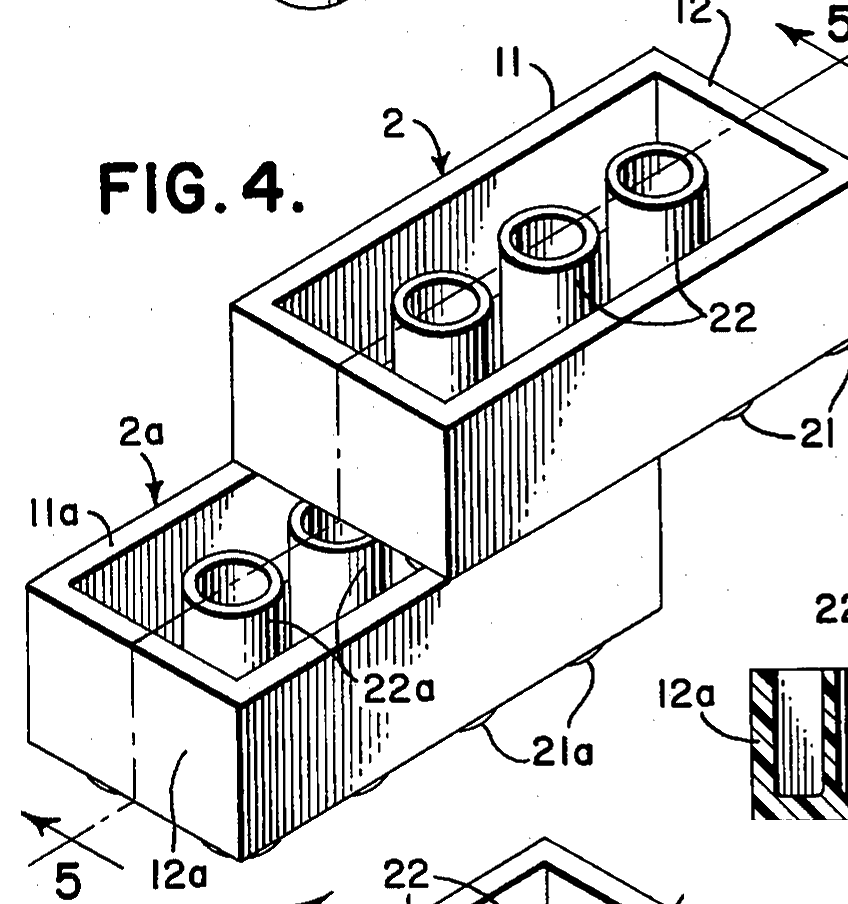
On January 28, 1958, Godtfred Kirk Christiansen filed for a "toy building brick." Read the whole patent and you won't find a millimetre in it. It defines the brick by what touches what.
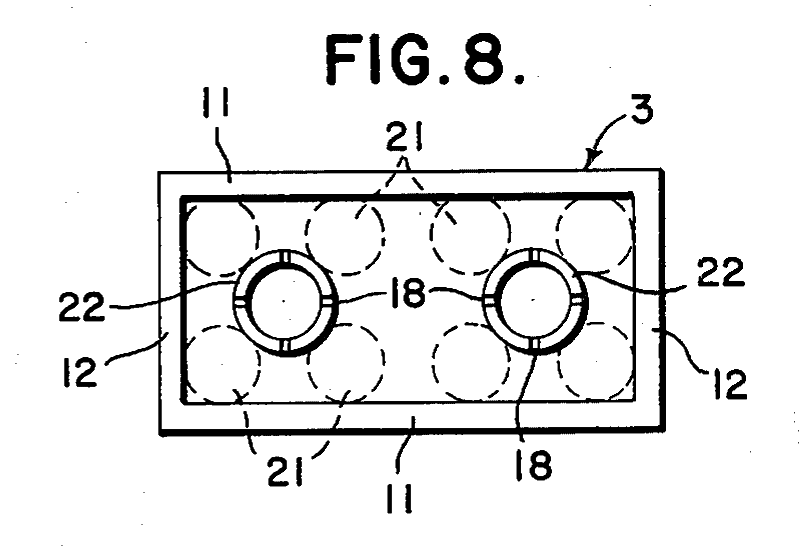
“Each of the secondary projections touches the geometrically projected cross sections of four primary projections.”
US 3,005,282, col. 2. Primary projections are the studs (21). Secondary projections are the tubes underneath (22).
And it says what that buys:
“This particular disposition … is the essential feature of the invention [and] provides for a vast number of possible combinations of adjacent bricks.”
US 3,005,282, col. 2
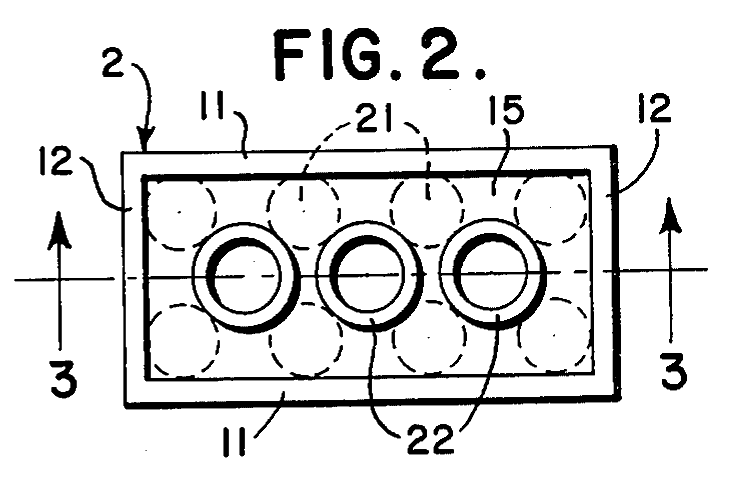
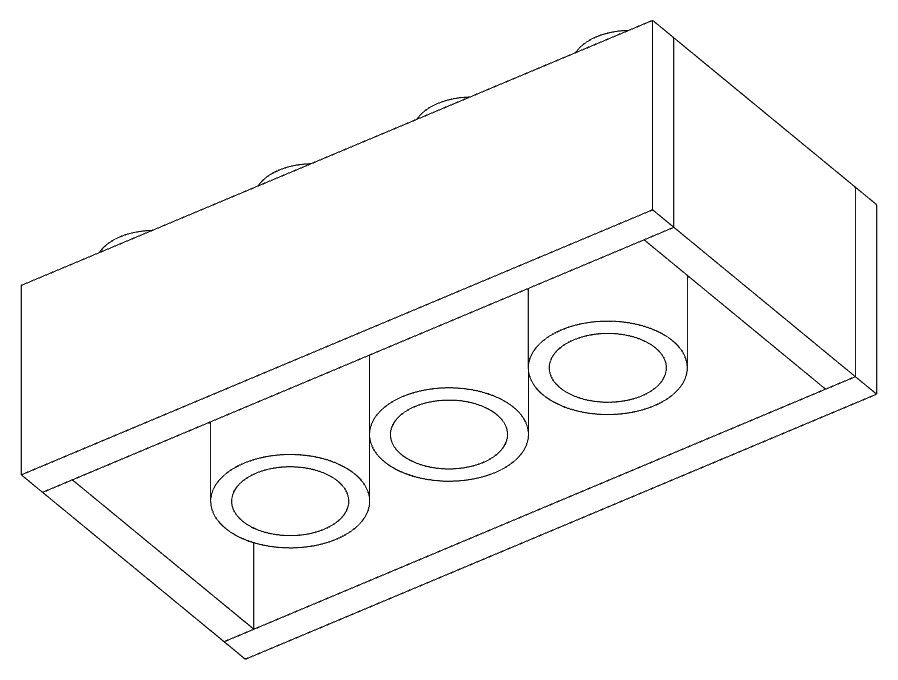
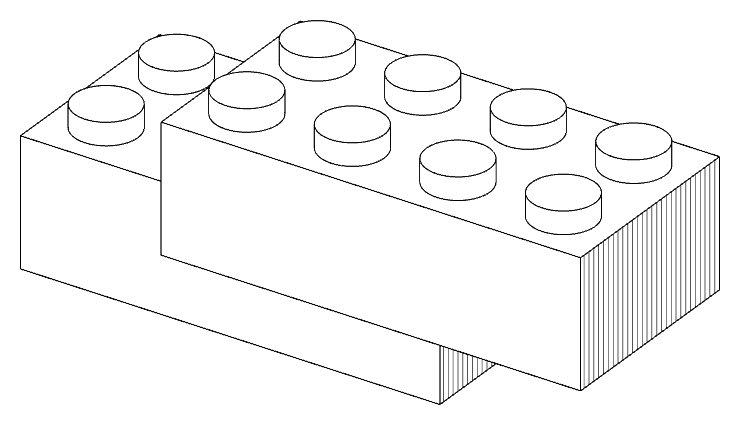
Here is that rule working. A tube sits wherever four studs meet, so the bricks lock at every whole-stud offset, not just when they're squared up. Drag the red brick and see how many ways it can sit.
Rung 1 One placement · drag it, tap it to turn it
Rung 2 All of them · tap one to try it
But "four studs touching a tube" doesn't say how big a stud is. So the patent leaves one thing open, and LEGO had to choose it.
Step 2 · One choice
Pick a stud, and the grid appears
Fix the distance between studs at 8 mm. Now choose how wide a stud is. The patent's rules do the rest: the wall thickens until it touches the stud, and the tube grows until it touches four studs.
Then ask a practical question. A toolmaker cutting the mould and a designer drawing new parts both want one small ruler that lands on every edge. How big can that ruler be?
Rung 1 One brick and its ruler · drag a stud's edge to resize it
Rung 2 Every choice at once. Drag across the bars.
Only a handful of choices give a usable ruler. At 0.5, the ruler is 2 mm. At 0.6, it's 1.6 mm, five to a stud. Everywhere else the ruler collapses into fractions of a millimetre.
LEGO's studs are 4.8 mm on an 8 mm spacing: 0.6. LEGO has never said why it chose 3:5 over 1:2; the patent gives no sizes at all, and later LEGO patents just state the number. Here's one reading of the chart: 0.6 is the fattest stud on a clean grid that still leaves the tube a real wall.
The reveal
One unit: 1.6 mm
Set the stud to LEGO's 0.6 and this band's studs split into the unit grid: five small squares to a stud. Every horizontal size LEGO makes is a whole number of these squares. The one exception is the tube, whose width hides a √2: 8√2 − 4.8 ≈ 6.51 mm.
That settles width and depth. But the patent never mentions height.
Step 3 · The open dimension
Height was a separate choice, and it doesn't fit
The patent is silent on height. Thin plates already existed: large waffle-bottomed plates arrived around 1955, and the small plates builders use today came in 1962–63. A plate has one job, to cover a stud from above, and on the 1.6 mm grid that takes a roof of one unit plus room for a stud one unit tall. Two units.
Rung 1 How thin can a plate be? · drag the plate's top up or down
Rung 2 Tip a brick on its side · tap bricks and plates to build a stack level with it
Rung 3 Every stack of plates at once · tap one to build it above
Here's the mismatch in plain terms. Sideways, everything is counted in studs, 5 units each. Upward, everything is counted in plates and bricks, 2 and 6 units. A stack of bricks alone is level with a stud count only every fifth brick. Mix in plates and it comes out level every 10 units, but never in between: a single stud is 2½ plates, so a piece one or three studs wide can't be matched by any stack at all.
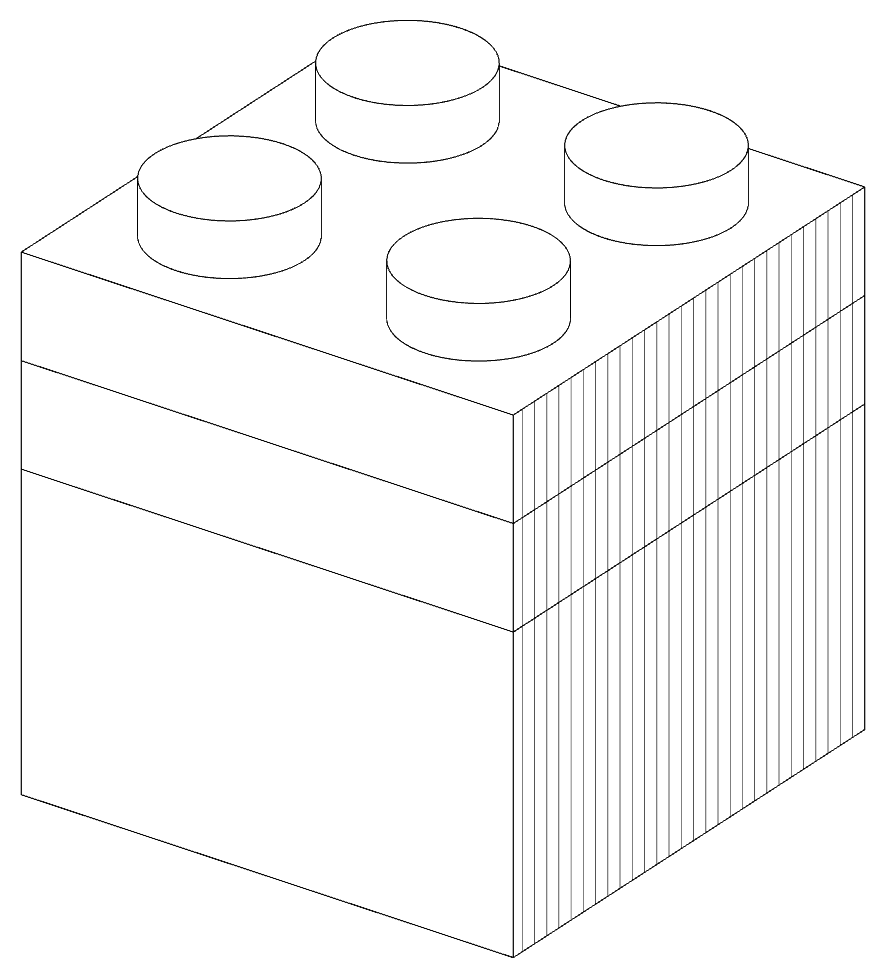
The most useful consequence is one builders lean on constantly: one brick plus two plates is ten units, exactly two studs. A 2×2 brick with two plates on top is a cube, 16 mm each way. Turn a piece on its side and that column matches two studs laid flat.
Two units is the grid rule. Real plates mould a slightly thinner roof and a deeper pocket, to clear studs that stand about 1.7 mm with the logo on top.
So LEGO invents adapters
Tipping a brick over is easy. Holding it there is the hard part: on its side, a brick has nothing to clip to. So LEGO keeps inventing parts with studs on their sides. Each is an adapter between the two ways of counting: it sits in a stack that rises in 2s and 6s, and offers studs facing sideways, where the next piece is counted in 5s. Builders call the technique SNOT, studs not on top.
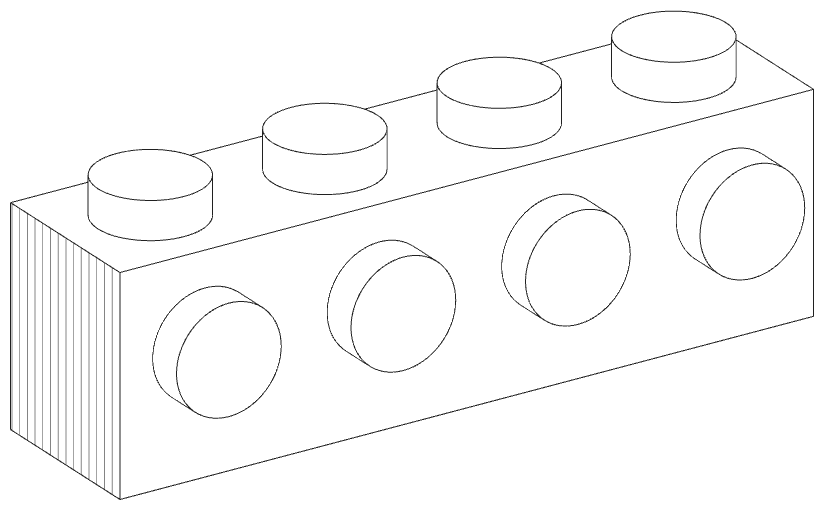
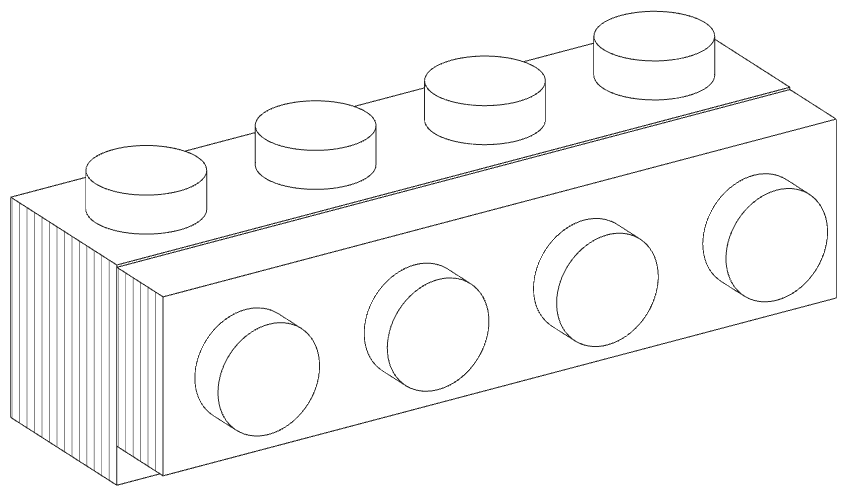
Width, depth and height are settled on paper. But a grid on paper holds nothing together.
Step 4 · Grip
The grid only works if every brick is the same
Zoom in. A stud is slightly wider than the space it pushes into, so the walls flex and hold it. That only works if every brick, from every factory, every decade, comes out the same size to within thousandths of a millimetre.
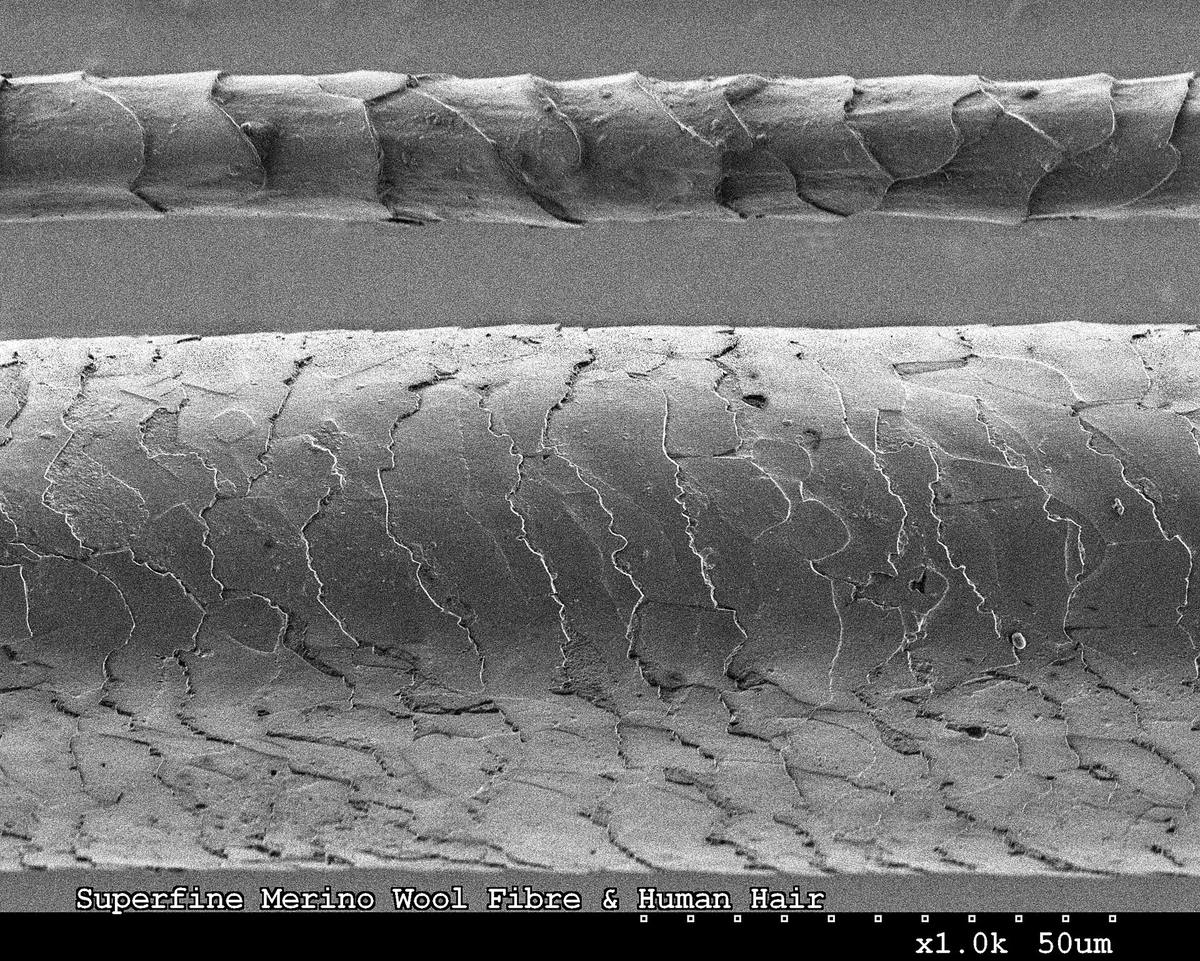

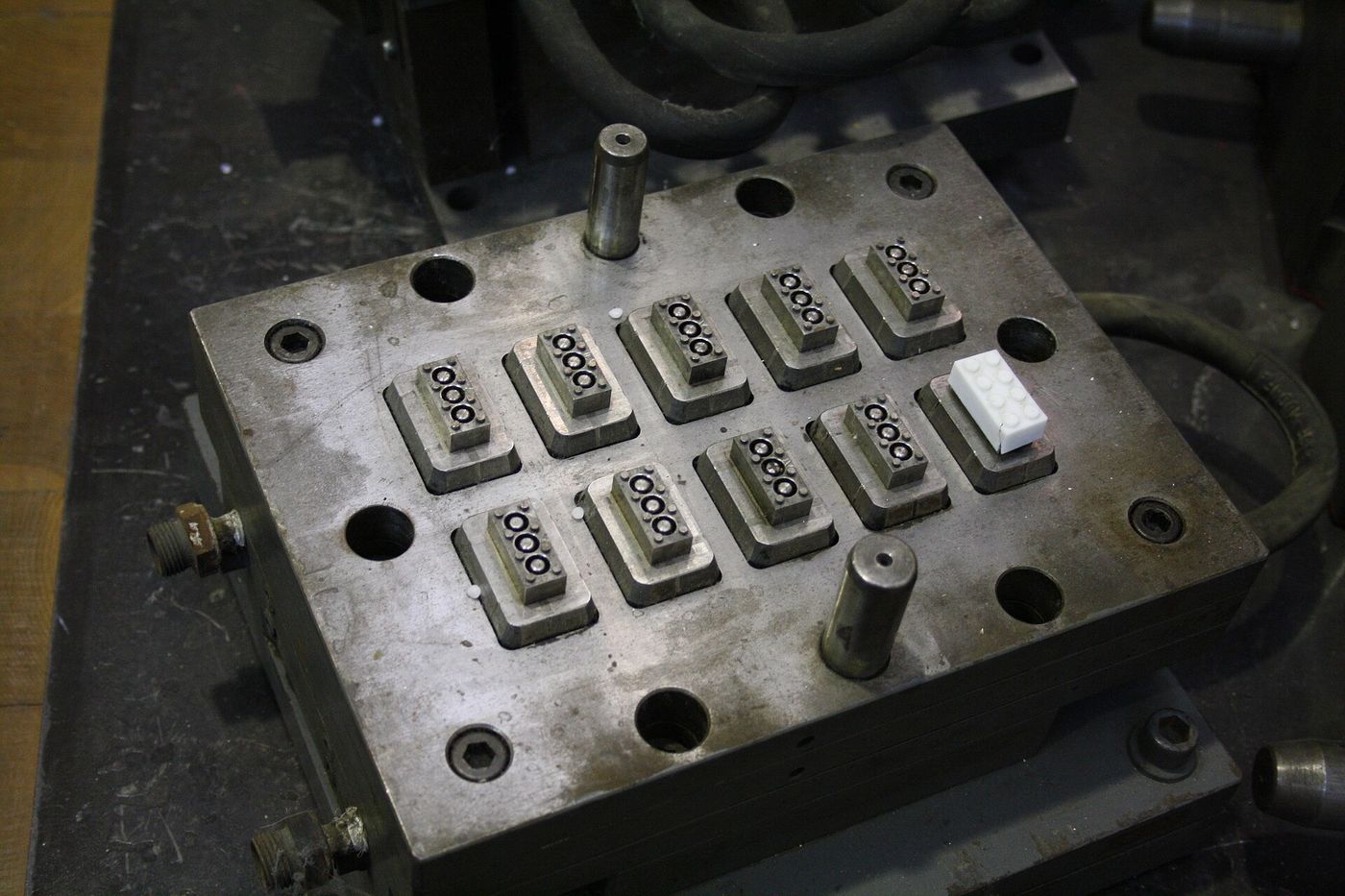

Sources: LEGO history pages (ABS in 1963 allowed moulding "to an accuracy of 1/200 mm"); The LEGO Group: A short presentation (LEGO Corporate Communications, 2011): moulds "accurate to within five my (= 0.005 mm)", knob tolerance "2/100 mm", 18 failures per million. Stud diameter ≈ 4.88 mm: Brighton Toy Museum micrometer survey. The often-repeated "2 µm" has no LEGO source.
A grid, made exactly, every time. So what does that buy?
Step 5 · The payoff
Six bricks, 915,103,765 ways
Back to the patent's promise of "a vast number of combinations." You already found the first number: two bricks make 24 different pairs. Now keep adding identical 2×4 bricks and count every distinct way they can connect. Each new brick multiplies the count, and the multiplier keeps growing.
The multiplier settles toward about 117 per added brick, by Eilers' estimate (proven to lie between 81 and 177). Nine bricks already give 816,630,819,554,486 structures.
Six identical bricks already outnumber any set ever sold. So why does LEGO make 9,000 different shapes?
Step 6 · New words
A few words do most of the work
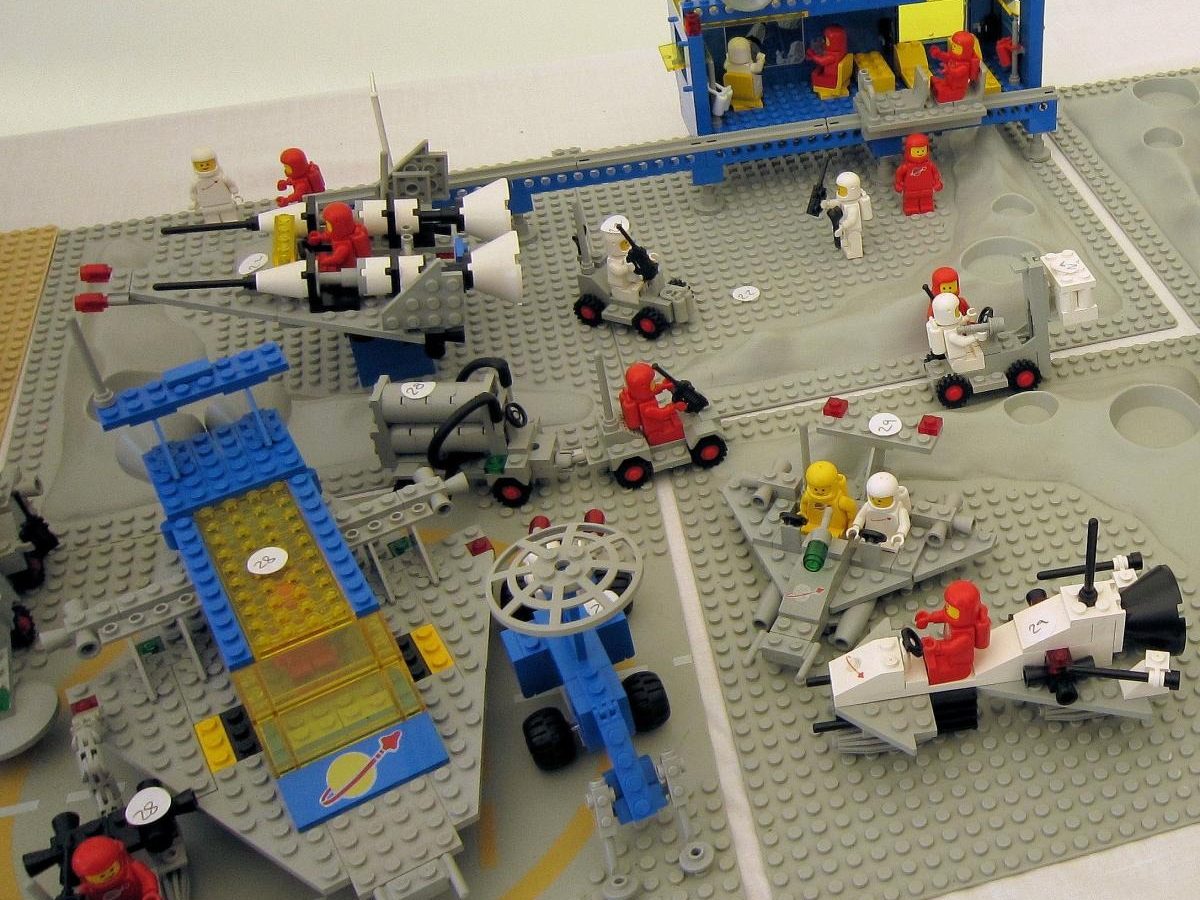
Each shape is a word, and each set is a sentence written with them. Across 14,644 sets in Rebrickable's records there are about 9,000 shapes. Most of the “writing” uses very few.
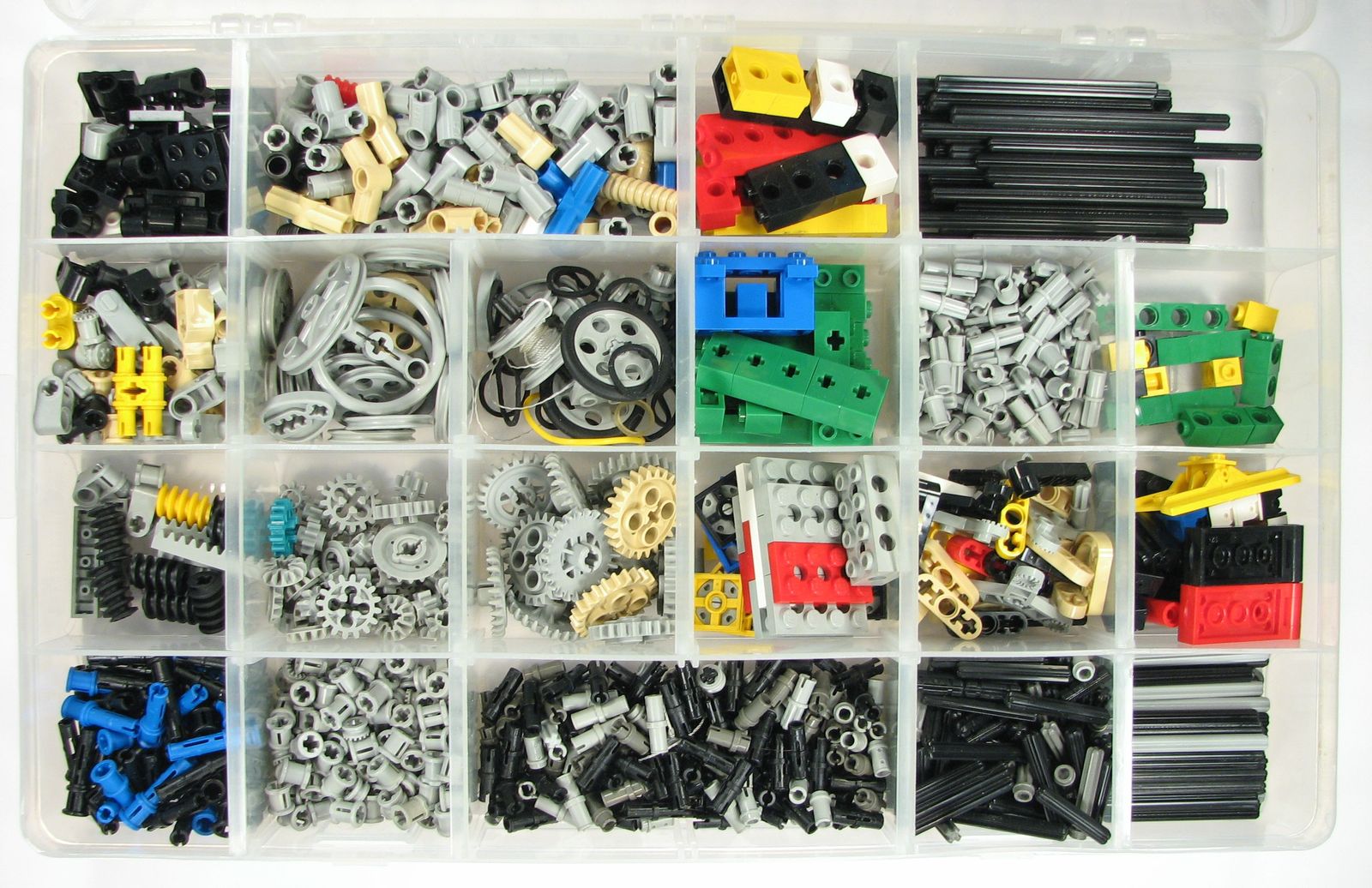
So are bigger sets just bigger samples of that vocabulary, or are designers doing something on purpose? Test it. Build a set by drawing pieces at random from LEGO's real catalogue, weighted by how common each shape is.
Rung 1 One set · drag the red handle to change its size
Rung 2 Every set size at once, against the real thing
Past 2,000 pieces, random picking needs about three times as many shapes as real sets use. Real sets look like a designer who reuses more as the set grows: a 20-piece set reuses a shape it already has 40% of the time, a 200-piece set 60%, a 2,000-piece set 80%. Big models are walls of the same brick and roofs of the same slope. (A designer who reuses a fixed share of the time, whatever the size, fits mid-size sets but misses at both ends.)
Why this matters for the system: because every piece fits every other on the grid, a designer can write a 2,000-piece model in a few hundred words, mostly the same bricks and plates again and again. That keeps the vocabulary small enough to manufacture. Every new shape is a new mould, so it has to earn its place. In the late 1990s, LEGO forgot that.
This is the check Mazzolini et al. (Physical Review X, 2018) call for: uneven popularity alone explains much of how LEGO sets share parts, so a random baseline comes first. Here it clearly misses, so the 0.63 exponent reflects design.
The bubble, and the extinction
Words also have a cost. Every new shape is a mould, and every new colour multiplies the inventory. Here the metaphor switches from language to genes. The vocabulary mutated fast in the late 1990s, and then came an extinction.
Fig. 8. Per year, across included sets: colours in use, distinct shape-and-colour elements in use, and shapes debuting. Colours went from 39 in 1997 to 102 in 2004, then 62 by 2007. Shapes barely dipped.
By David Robertson's account in Brick by Brick, LEGO's element count went from about 6,000 to 14,200 between 1997 and 2004 (an element is one shape in one colour), and 90 percent of the new ones were used just once. The 2004–06 turnaround cut it to about 7,000. My own count above uses a different definition: 41–48% of elements debuting in 1999–2005 appeared in only one set within three years, against about 30% today. Same direction, smaller.
After 2004, new shapes got a budget. Designers spend yearly "frames": each new shape, new colour, or revived part costs one. So where does a new set's novelty come from now?
Step 7 · Sentences
Every set gets one word of its own, mostly in paint
Below are eleven sets, from a 1978 castle to a 2024 Hogwarts hat. Under each is what it contained that no other set had within three years of its release: its word of its own. The swatch is the actual colour.
Rung 1 Eleven sets, side by side · tap one to find its year below
On a phone, swipe the cards sideways.
Rung 2 Every set, every year
Since the mid-2010s, 63–74% of sets carry something you can only get there, up from about half in the 1980s. Only about 5–7% get there with a brand-new mould. The usual hook is a new colour of an existing shape, then a new print, then a new minifigure.
Themes speak dialects
Fit each theme on its own and the curves differ. Brickheadz, Creator and Technic reuse the most. City and Ninjago add new words fastest as sets grow.
Thousands of new words, dozens of dialects, seventy years. And the 1958 brick still fits.
Step 8 · Still fits
Every new word obeys the 1958 grammar
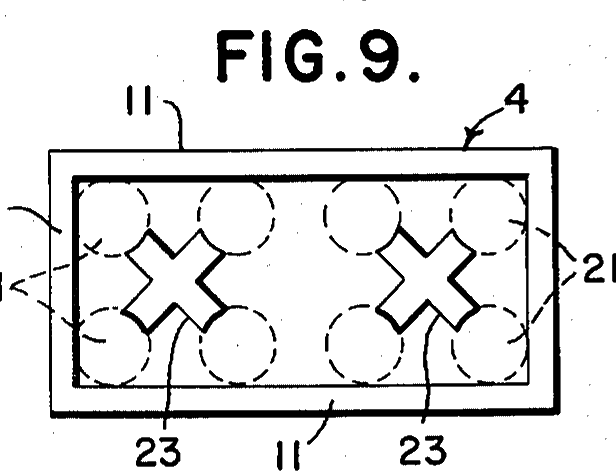
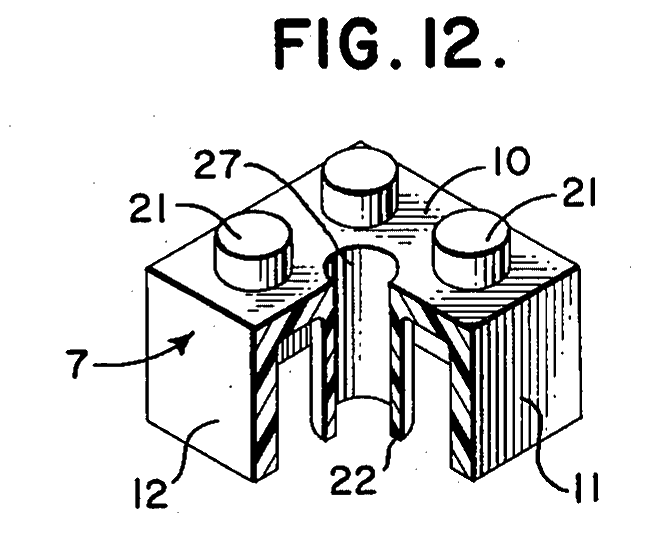
Go back to the patent. It also sketched tubes shaped like crosses, tubes with slits for extra grip, and a square brick with a hole down its middle for "a cylindrical connecting member," purpose unstated. LEGO took up rods and axles later: wheel bushings in a 1962 patent, axle bricks in 1970, Technic in 1977. Nothing ties those back to this drawing. Call it a rhyme.
What survived is the rule underneath them all: circles that touch. A new shape can be anything, as long as it meets the grid where the grid expects it. LEGO puts the result plainly: "two LEGO bricks produced 60 years apart can still fit together."
LEGO isn't a toy you buy. It's a system you join. Godtfred put it in four words in 1963: “More LEGO, multiplied play value.”

Go deeper
Notebooks this grows into
The tree of interlocks: every way LEGO parts connect, rooted on the stud, with the dates each branch appeared. The vocabulary notebook: dialects, the null model, and the 2004 extinction in full. The floor: exclusives by theme. 915 million: the counting problem, hands-on.
Sources and method
US 3,005,282, Toy building brick, drawings reproduced from the public-domain patent · US 3,234,683 (wheel bushing, 1962)
Rebrickable database, pulled Oct 20, 2026: 14,644 sets, excluding Duplo, Gear, books, bulk and service packs, education, collectible-minifigure bags, stickers. "Shape" merges prints and mould revisions.
LEGO history: moulding philosophy · quality in every detail · the 10 characteristics · 60th anniversary
The LEGO Group: A short presentation (2011) · Brighton Toy Museum: LEGO dimensions
Eilers, A LEGO counting problem · OEIS A112389 · Durhuus & Eilers, On the entropy of LEGO
Changizi, McDannald & Widders (2002), Scaling of differentiation in networks, J. Theor. Biol. 218 · Mazzolini et al. (2018) · Bartneck & Moltchanova (2018) · Robertson, Brick by Brick, p. 113 · New Elementary on frames
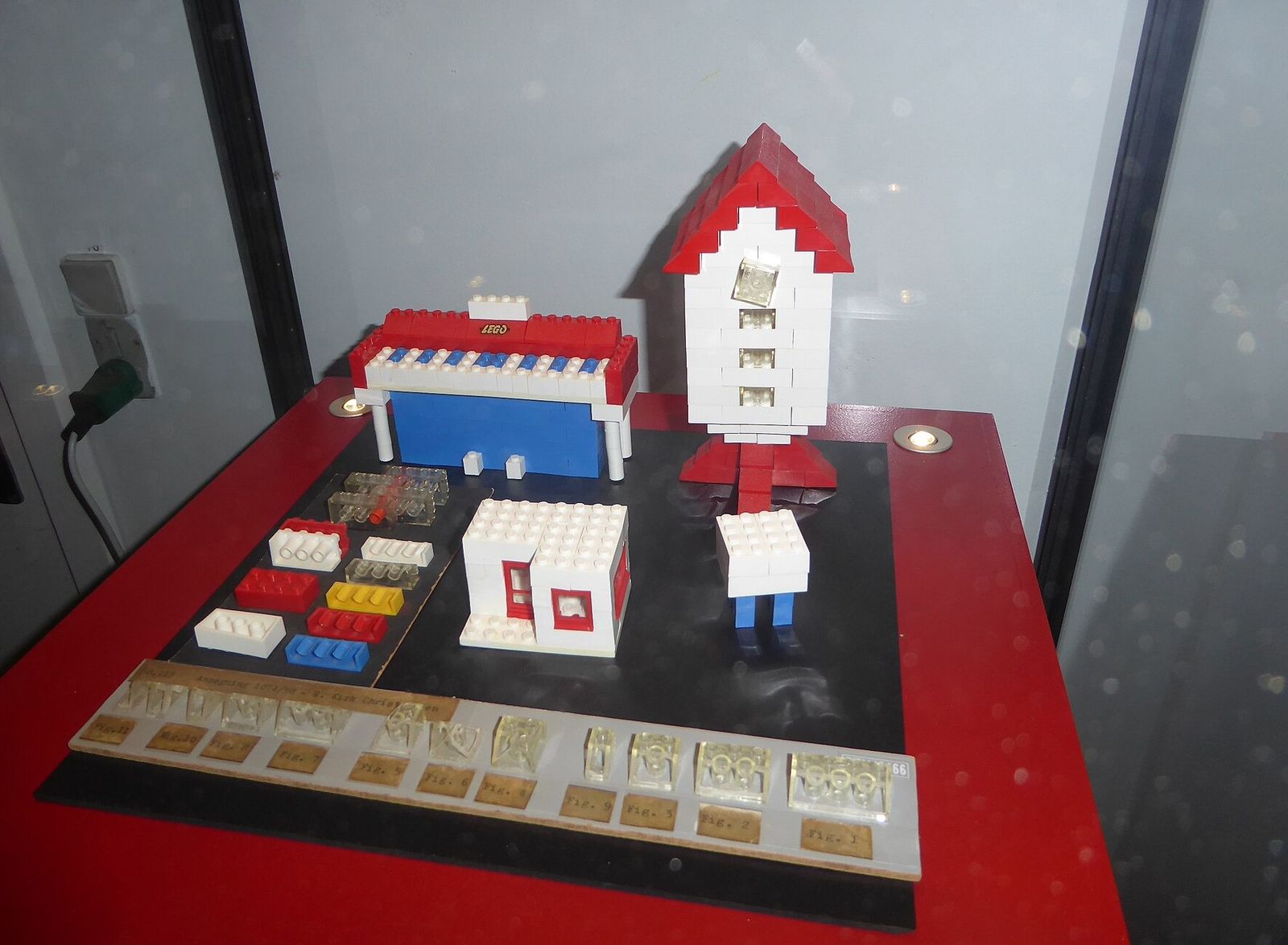
Photos from Wikimedia Commons, credited under each, resized and in some cases cropped: Ziongarage (CC0), CSIRO (CC BY 3.0), Arne Hückelheim (CC BY 3.0), Leif Jørgensen (CC BY-SA 4.0), Windell Oskay (CC BY 2.0), Dave Catchpole (CC BY 2.0).
Line renders: drawn for this page from nominal dimensions (pitch 8, brick 9.6, plate 3.2, stud 4.8 mm) with three.js.
LEGO® is a trademark of the LEGO Group, which does not sponsor, authorize or endorse this page.