Clutch is overrated
By Jeremy Britton and Andres Alvarez · First published in the Wages of Wins Journal
Andres “Dre” Alvarez and I wrote this for Dave Berri’s Wages of Wins Journal. That site went dark in 2021, so this is a rebuilt copy: the original text and images, plus the comment thread. The original lives on at the Internet Archive.
Brace yourselves. You can now browse the last ten years of play by play data with ease at Basketball Reference. The first place many have looked was at the very ends of games to find out about clutch. Jeremy and I decided to retell an old story about clutch for the 2010-2011 season with the new data.
Clutch Players shoot more
There’s nothing surprising about this finding. With the game on the line the clutchest players want the ball and increase their shots per minute.
Clutch players shoot worse
Of course when crunch time hits our clutch players have a tendency to shoot worse from the field. In fact, only Monta Ellis and Carmelo Anthony saw an improvement in their effective field goal shooting.
It doesn’t matter
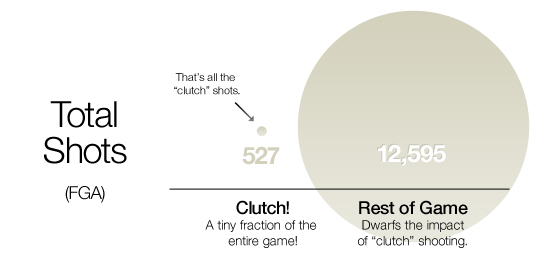
It turns out that players that like to shoot in the clutch also like to shoot during the rest of the game. It also turns out clutch time is a small portion of the game and it doesn’t happen every game. Add up all the clutch shots and it’s only around 4% of the total shots our top clutch shooters take.
Summing up
With an ability to look at clutch data closer it is very tempting to use it examine certain clutch players with a closer lens. And certainly it is also tempting to try and explain clutch time. Our players must be taking riskier shots at a quicker pace. Or maybe the defense really clamps down in clutch. In fact it’s pretty easy to believe that teams will change their strategy in clutch time and equally easy to believe they will not make optimal decisions.
What is important to do though is to temper this with how important it is. LeBron James was not clutch last season and neither was Dwyane Wade (whereas Carmelo Anthony and Monta Ellis were). That didn’t stop the Heat from winning lots of games and making it to the finals. We’re likely to overestimate the odds or importance of an event based on how easy it is to remember. Clutch shots are a great example of this. I’m not saying clutch shots aren’t fun, or memorable or even not important. I’m just saying perhaps we shouldn’t be so quick to define players based on actions that make up less than 5% of their offensive plays.
-Jeremy and Dre
Clutch was defined as any shot taken with two minutes left in the fourth quarter or overtime with five points or less between the teams. The top ten “clutchest” players (Russell Westbrook, Kevin Durant, Derrick Rose, Kobe Bryant, Monta Ellis, Andre Iguodala, Jason Richardson, LeBron James, Carmelo Anthony and Tyreke Evans) were used and were defined as those that had the most shots in clutch time for the 2010-2011 season.
Comments
11 comments, rebuilt from the Internet Archive’s copy of the original thread.
mettaworldpiece February 21, 2012, 3:47 am
What about FT shooting? Do clutch players get to the line more often and do they make more FTs?
I think the notion of clutch is certainly overrated, but I’d be more interested in the opposite. Are there players that are severely unclutch? That wouldn’t be a dip in overall performance but a huge dip. Especially at like the FT line or wide open jump shots (according to synergy).
Andres Alvarez February 21, 2012, 8:02 am
Metta,
Great question. The data at Basketball-Reference was not as easy to parse for that but it is next on my to do list. Dan Ariely’s work on this did show an increase in Free Throw attempts. So the next question will become – does the dip in shooting effectiveness get counterbalanced by an increase in trips to the line? Hopefully I or someone else will get to that soon!
EntityAbyss February 21, 2012, 9:35 am
Arturo said he wanted play-by-play data to help him with his version of wins produced. I wonder if this is what he meant.
lovethoseknicks February 21, 2012, 6:20 pm
I think a dip in efficiency is to be expected in clutch situations because that’s when the defense gears up 100% and focuses its attention on the “go to” scorers. In fact, in very late game situations coaches often make substitutions depending on if they are on offense or defense just to maximize a single possession.
I think the only way to really test this would be in a controlled experiment where the big name “go to” scorers faced the same exact conditions as more average players.
Steve Kerr probably had decent clutch stats while on Chicago because he was getting wide open looks off Jordan’s doubles, but do you want him shooting in the clutch off the dribble while covered by the team’s best defender?
Andres Alvarez February 21, 2012, 11:07 pm
LTK,
Don’t know if a controlled experiment is possible. That said, I’m actually coming more around to your defense idea in clutch. In clutch times offenses change their strategy. As I already cited, it looks like teams that are up that try and waste the clock are actually making a mistake akin to punting on fourth down in football even if they have favorable field position.
Also saw this today – http://espn.go.com/blog/truehoop/post/_/id/37405/evidence-timeouts-hurt-scoring
Similar idea. In clutch times teams are more likely to call time-outs on offense. And as you mention their strategy of go-to scorers and risky shots goes up. It may be the case (I still need to verify free throw shooting) that the defense in clutch time behaves “rationally” whereas the offense behaves poorly and you get the defensive gear up you mention.
lovethoseknicks February 21, 2012, 11:42 pm
Andres,
I know it’s not always a good idea to trust what you see, but sometimes I don’t have anything else to work with. I do my best to be objective. I watch a ton of basketball. Even though I can’t tell you everything that changes, there are differences at the end of games.
The timeout example is a good one.
Andres Alvarez February 21, 2012, 11:46 pm
LTK,
I agree on the end of games. Heck maybe coaching does have another impact in terms of how they handle close games. Of course I think most coaches behave the same here. I am really leaning more towards the idea of a clutch player is a misnomer. Abbott has been big on this. In close games you should always just go for the best shot. Teams change their strategies in ways that decrease their shooting efficiencies. So I think when it comes down to a clutch player the more important question is if the offense is behaving correctly.
annoyedstatistician February 22, 2012, 9:11 am
A few things:
1) Your subset of players is wrong. Click on the basketball-reference.com link you provide and sort by FGA; the 10th player by FGAs is Al Jefferson, not Tyreke Evans. That takes the eFG% of the top-10 clutch players (by your definition) up to 45.3%.
2) Even by your measure of clutch, the data show the exact opposite to what you claim — clutch shooting is alive and well. Start with the same list, take all the players who attempted at least one clutch field goal (318 players in total) and remove your top-10. We get the following eFG% on clutch attempts:
top-10 clutch : 45.3%
rest of league: 42.7%
Now take all the field goals from last season and subtract the clutch attempts. We find the following eFG% on non-clutch field goals:
top-10 clutch : 49.9%
rest of league: 50.0%
In other words, scoring in the clutch is difficult for everyone, but the top-10 guys are much better at it than the average player.
[out of words!]
annoyedstatistician February 22, 2012, 9:15 am
[continued]
3) As mettaworldpiece pointed out, this analysis ignores the fact that all of these top-10 players have an above-average foul-drawing rate, which could well increase their overall scoring efficiency even more. Take a look at this: http://www.82games.com/1011/CSORT11.HTM
4) Of course the clutch is a tiny fraction of the entire game. However, teams find themselves in that situation very often, and having players who can score even with moderate efficiency is obviously valuable, given that the average player shoots terribly in this situation.
5) Finally, and perhaps most importantly, looking at such tiny groups of players is inherently problematic (as the effect of the Jefferson-Evans swapped illustrated), and the choice of cut-off point is arbitrary. Why take the top-10? Why not 5 or 8 or 20 or 30?
lovethoseknicks February 22, 2012, 9:29 am
Andres,
I’m not sure how much Knicks basketball you watch, but there was a good example of NOT taking a timeout a few nights ago.
The Knicks had the ball very late in a close game. I think there were about 10 seconds left. The announcer actually said that Mike D’Antoni didn’t call a timeout because he didn’t want to give the defense a chance to set with that much time left for his team to get a good shot. Lin knocked down a 3 pointer.
Andres Alvarez February 22, 2012, 9:55 am
Annoyed,
Hmmm curious on Evans, could have sworn he was 10th. Thanks for the catch. Awesome work on the rest! I don’t discount this by the way. As you might be able to tell from the thread I’ve been having with LTK it seems the data supports that during clutch time teams take less efficient shots.
I can’t give you 4. Clutch games account for less than half the games and clutch time accounts for a very small portion of those games. In terms of the rest I am very happy to see all of your follow up questions. I’d love to see a write up if you have a blog and if not it may be something we’ll come back to.
Linked from