Battle of the Barnes: could the Warriors have been the Clippers?
By Jeremy Britton · First published in the Wages of Wins Journal
I wrote this for Dave Berri’s Wages of Wins Journal. That site went dark in 2021, so this is a rebuilt copy: the original text and images, plus the comment thread. The original lives on at the Internet Archive.
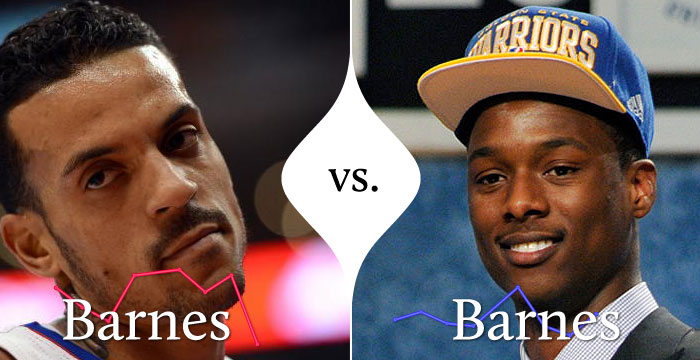
How would the Pacific Division be different if the Golden State Warriors had signed Matt Barnes to play small forward rather than draft Harrison Barnes to do it? The Warriors would be in first place, that’s how the division would be different!
If we were to simply reverse the two players–trading Matt for Harrison and playing what-if for the season to date–then the Golden State Warriors would gain about four wins while the Clippers would lose four. The resulting standings would look something like this today:
| Hypothetical Record in Bizarro Barnes-Land | Games | Back | Winning % |
|---|---|---|---|
| Golden State | 29-11 | - | .725 |
| Los Angeles Clippers | 28-15 | 2.5 | .651 |
| Los Angeles Lakers | 17-23 | 12.0 | .425 |
| Sacramento | 16-26 | 14.0 | .381 |
| Phoenix | 13-28 | 16.5 | .317 |
Total Bulls**t!
Here goes Wages of Wins again, right? We are about to say something absurdly good about a player who people say is obviously not so good. We are about to say something about this player being much better than you would think… significantly better, in fact, than another player who you would think of as being good instead. Why do we keep doing this!?
Science teaches us to think systematically in a world that thinks anecdotally; abstractly from 10,000 feet above when everyone else sees single concrete examples planted firmly on the ground. This kind of systematic thinking runs the risk of alienating readers by sounding downright autistic, as some commenters have been happy to let us know. Perhaps the trick to telling stories from 10,000 feet up is knowing how to do it without ever leaving the ground.
Who cares about Matt Barnes?
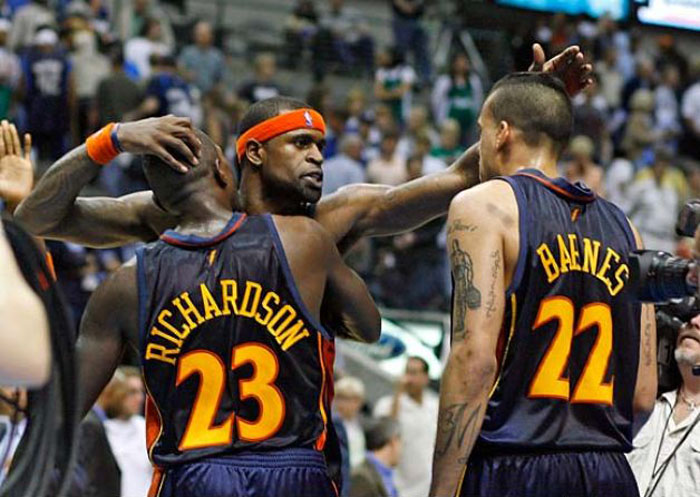
As a fan of the Golden State Warriors, I care about Matt Barnes. Not long ago the Warriors were a bad team that failed to make the playoffs for 13 consecutive seasons. Then in 2006 they were still a bad team with a record of 26-35 until something miraculous happened: they won 16 of 21 games to sneak into the playoffs with the 8th seed. This and the subsequent playoff run became known as the “We Believe” team, inspired by Matt Barnes’ neck tattoo reading, “BELIEVE.”
In addition to his tattoo, people said Matt Barnes brought tough defense, locker room presence, and hit big shots when it mattered. He was not a star, but a role player who helped the team’s chemistry to gel. The fact that Matt only scored 9.8 points per game while offering no other notable statistic seems to reinforce his status as supporting cast. He only played one additional season for the Warriors–a season they finished 48-34–before taking his services to the Suns, Magic, and then most recently the Lakers.
This past offseason Matt Barnes was a free agent. The Warriors publicly expressed interest in improving their small forward position–the one Matt Barnes plays–but declined to extend Matt an offer to play for them again. The local press cited “character issues” as a reason they stayed away. Matt signed a one-year contract for the veteran minimum salary with the Los Angeles Clippers instead. The Warriors drafted another Barnes–Harrison Barnes–with the seventh pick in the draft lottery to fill small forward need. Clearly they did not believe Matt Barnes nor his tattoos would bring them success.
Comparing Barnes’es
What do most of us see when we compare Matt Barnes to Harrison Barnes? Matt is an older journeyman, Harrison a rookie lottery pick full of potential. Matt has played 26.6 minutes per game for the Clippers while Harrison has played 25.6 per game for the Warriors. Matt scores 11.3 points per game while Harrison scores 9.2. The Clippers lead the Pacific Division with a record of 32-10, while the Warriors hold second place just behind them with a record of 25-15. Six games can be said to separate them.
In order to see how these two players’ contributions stack up, let’s zoom out a few thousand feet to compare them using all those wonderful boxscore metrics the NBA bothers to record in detail. These metrics let us see aspects of the game and these players that our naked eyes are not good at seeing when we are at the game or watching on TV.
We know from using science (!) to model the NBA that basketball is a game of possessions more than it is of points. Teams exchange the same number of possessions each game–not unlike ping pong–so for a player to help their team win they need to spend possessions wisely (shoot well, not waste it by turning the ball over, assist teammates), create do-overs (offensive rebounds), prevent opponent do-overs (defensive rebound ‘keep-aways’), and cause their opponent to spend possessions poorly (block shots, steal the ball back, avoid fouls). How well do our two Barneses do these sorts of things?
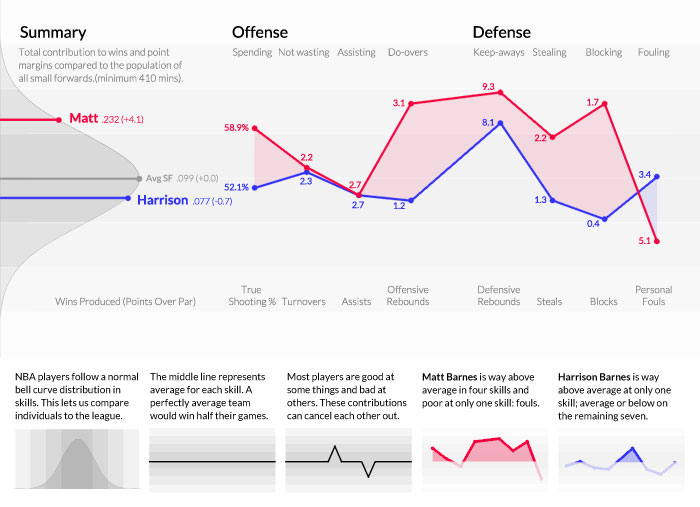
What can this information tell us? It tells us that Matt Barnes is a much better small forward than Harrison Barnes. In fact, it tells us that Matt is in the top 16% of small forwards in the league, whereas Harrison is below average. Multiply their Wins Produced (per 48 minutes) to the minutes they have played, we see that Matt has produced 5.4 wins for the Clippers, whereas Harrison has produced only 1.5 for the Warriors. This difference is enough to separate first from second place in the Pacific Division this year. But why?
When Matt spends possessions, he shoots exceptionally well. He is also one of the league’s best small forwards at getting his team do-over rebounds when they miss. Harrison does neither of these things well.
On defense both Matt and Harrison are among the best at keeping the ball away from opponents by rebounding it, however that is all that Harrison contributes to defense right now. Matt, on the other hand, is good at stealing the ball away and great at blocking shots. It is hard for opponents to beat the Clippers when Matt Barnes is blocking 1.7 of their shots. It is easier for opponents to beat the Warriors when Harrison is only blocking 0.4, much less than the average Joe Schmoe small forward.
Hindsight? Foresight?
Should we have seen Matt Barnes’ productivity coming? Yes. His 4.1 points over par follows previous years of 3.7, 3.3, and 3.1. His career wins produced per 48 minutes stands at .149 or half again above average (.099). Matt Barnes is producing slightly better than he has in the recent past. This should have been expected and rewarded with a lot more than a one-year contract for minimum salary.
But wait a minute! Harrison Barnes is a much younger player. He is on a cheap rookie contract and figures to get better over time. It is ridiculous to compare a veteran to a rookie and ignore the long-term strategy of building around youth, right?
Yes, sort of! Harrison Barnes is actually above average for a rookie and we should expect him to improve with time. This is great news for Warrior fans. However, he is beginning his career at a mighty deficit. His record so far in the NBA and in the past at college suggests he is a poor shooter who loves to shoot. That is a dangerous combination typically rewarded with high dollar contracts while producing few wins.
Put it this way: Matt Barnes is costing the Clippers about $154,000 per win he produces this year. In contrast, Harrison Barnes is already costing the Warriors $1,706,000 per win he produces this year. And Harrison’s cost will rise with the points he scores. Again, he will improve, but he is starting out at a costly deficit for his team.
We Believe
Stories will get told and retold about players like Matt and Harrison that reinforce the wisdom of what people already believe–for instance, that Matt Barnes is a limited role player or that Harrison Barnes is an up-and-coming rookie with tons of potential. Lost in these concrete stories about personalities and intangibles is the ability to see the game with a better view thanks to some know-how combined with the right numbers.
What this Barnes vs. Barnes thought experiment highlights is how out-of-whack player evaluation in pro basketball can be and how capricious winning and losing is as a result. The NBA’s top team would be in second place in their own division, while a perennial also-ran would be in first place instead. All because of a player nobody cares much about.

Comments
15 comments, rebuilt from the Internet Archive’s copy of the original thread.
Brian January 24, 2013, 2:34 am
Well, there’s always this:
http://www.nba.com/warriors/news/brandon_rush_surgery_012113
Mike January 24, 2013, 5:07 am
LOVE that info-graphic,and love to help someone code it up – looks amazing.
Scott McClintock January 24, 2013, 9:57 am
I don’t know the answer to this. How does Matt Barnes rookie season compare with Harrison Barnes current rookie season?
Jeremy Britton author January 24, 2013, 10:35 am
Thanks for the comments so far! I just want to reiterate that the Barnes-for-Barnes swap this season is really a thought experiment to highlight something more important: *how* we evaluate players. The information graphic is an attempt to show a better comparison between two players and to the entire population of small forwards this season.
Mike, I would love to collaborate. I have some ideas about how to do just this (I’m currently experimenting with a library called D3). DM me on Twitter @forgttenboy.
As for the long-term wisdom of actually swapping these two players before the season, I think there is a strong case that Matt Barnes will continue to be by far the cheaper and more productive option on into the future.
Tommy Grand January 24, 2013, 10:56 am
Great article.
Jeff January 24, 2013, 11:09 am
The infographic is incredible. Really well-done and drove the point home. More please.
Daniel January 24, 2013, 11:28 am
Nits: 2006 season math would work out to 42-42, not the actual 42-40 record. And I think Harrison was the 7th pick.
Great post. I miss Matt Barnes. And Brandon Rush.
Andrea Bargnani January 24, 2013, 11:43 am
Matt Barnes’s first 3 seasons’ WPs were 0.081, 0.079 and 0.036. Might be a bit early to call Harrsion an Bargnani Americano yet.
JGlanton January 24, 2013, 11:43 am
I’ve gone to some Clipper games this season and had a lot of close-up looks at Barnes playing. I don’t believe that there is a player in the NBA that plays harder than him. He’s never idle. He sprints full-speed on fast breaks even when he has little chance of touching the ball. Then he sprints full-speed back like he’s training wind-sprints. He’s always moving, harassing, tipping, bumping, running to the corner then running back to the paint for a rebound attempt. During a timeout, he goes back to the bench looking pissed and deep in thought about how he should have done better. Dude is a gem. And the most underpaid player in the NBA.
Max Kuhl (@MaxwellKuhl) January 24, 2013, 1:02 pm
Really interesting piece. I agree that player evaluation is flawed, especially when it comes to players like Matt Barnes, who is a great example of the tension between “anecdotal” character issues (perception) and on court success (reality). However, I think brushing over that tension (“Clearly they did not believe that Matt Barnes nor his neck tattoos would bring them success”-do you know for a fact that the decision was that simple?) as though the Warriors front office makes personnel decisions in a vacuum runs a much greater risk of alienating readers than simply presenting the facts and numbers and graphs, which are themselves very persuasive, and leaving room for some subtlety. Anecdotal, or “intangible” things (e.g. Matt Barnes’ relationship with the Warriors’ front office; Rush’s injury; Harrison Barnes playing against starters vs. Matt Barnes playing more bench players) and statistical things (like those you point out) are probably mutually inclusive, which is something that you allude to when you mention the ability to see the game with those in combination, but it doesn’t seem like you actually want to combine them.
Jeremy Britton author January 24, 2013, 2:00 pm
Tommy and Jeff, thanks. I’m glad you liked it.
Daniel, thanks for catching the info I misquoted in the background about Matt and Harrison. I’ve double checked those and corrected the 2006 record prior to the late season run and the mention of Harrison as eighth and not seventh pick. Thanks for the assist!
“Andrea,” I’m not sure who is calling Harrison the next “you.” Harrison is above average for a rookie and is very young. It is not far fetched that he become an above average veteran player in the near future given his efforts thus far.
JGlanton, I agree about Matt Barnes. His visible effort not only looks quite high, but very consistent just like you describe so well. My hypothesis is that his kind of effort puts him in a position to make a winning contribution by working to get closer to the ball (to steal it, block it, or rebound it). Doing this is really difficult.
Arthur North January 24, 2013, 2:11 pm
Would just like to point out that Matt Barnes may have even more value in comparison to Harrison Barnes because the Clippers are weakest at the forward position. Their second best SF behind Barnes is Odom who isn’t even a SF. Butler is awful and Hill hasn’t shown any signs of being good so far. Harrison however is ahead of Draymond Green and Richard Jefferson in the depth chart. While both of them are below average in terms of production, they are not nearly as bad as Butler or Hill. The more minutes Barnes plays the fewer Butler and Hill can play which adds to his value (although not in a way which Barnes has control over).
julienrodger January 24, 2013, 7:11 pm
Nice article. To me one thing people don’t realize enough is that getting spot up 3pt shooting role players at the SF position is kind of hard. There’s guys like Barnes, Korver, Battier, but after that it’s hard to think of many. Getting 3pt shooting from the SF position is a big asset because of spacing. With a 3pt shooting SF on the floor, if the PG and SG hit them, you’re looking at at least 3 3pt spacers, possibly 4 with a stretch big. Also if a team just so happens to have a star PG or SG who doesn’t hit 3s that well, it’s a huge help for them to replace it with a SF who does. On top of that of those SFs who hit 3s, very few of them are good defensively like Barnes is. Barnes is a more rare player than he’s given credit for or paid for
Barry M January 26, 2013, 3:21 pm
i have Harrison Barnes in a dynasty league. The good thing is he is only 20. That is about it.
Matt Barnes is one of the more enjoyable bench players to watch in the league. Always going full blast. He would be in any rotation in the league. There are other guys like him. Delante West is one. I think the tats and a few loose screws make these guys journeymen instead of players in demand. I recall Barnes destroyed Dallas in 2007. I will never understand why Avery Johnson laid down the second to the last game of the year against GS, as they were the only team in the league that gave Dallas problems that year. Barnes was a huge part of that.
James Washington January 27, 2013, 6:05 am
The Warriors tried to keep Barnes but he made the Bonzi Wells mistake. They offered him the mid-level exception (somewhere in the $25-$30mm for 5/6 yrs range) and he thought he could get more elsewhere ( I think he wanted $35-$40mm). Had he taken that he would have been in a much better or more respected place (definitely richer). Instead he signed a one year deal that hinged on him having a bigger season than the previous one to get the big contract and the Warriors ultimately gave the contract he wanted to Stephen Jackson.
Linked from